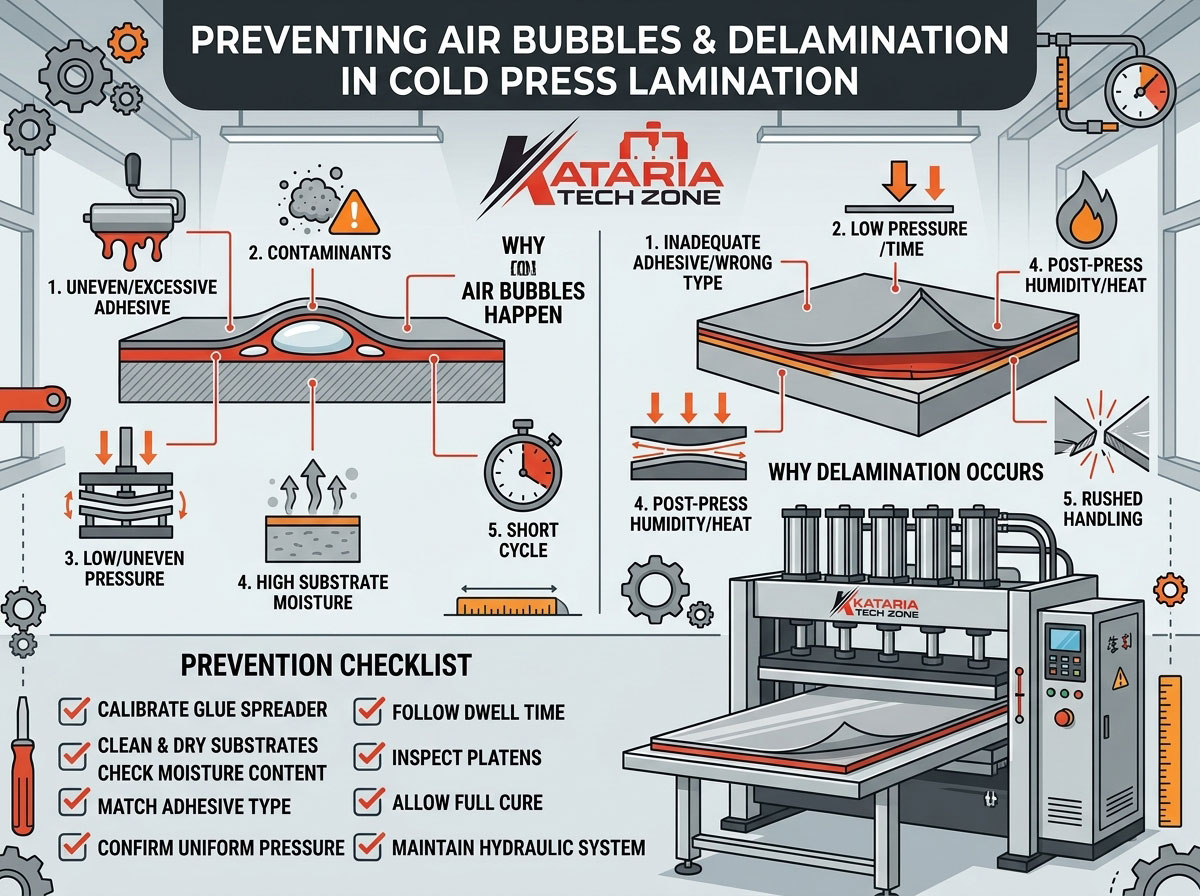
Air bubbles and delamination are two of the most common — and most expensive — defects in cold press lamination. A panel that looks perfect coming out of the press can bubble up days later, or peel apart the moment it’s cut or edge-banded. For manufacturers running high-volume laminate, veneer, or plywood production, these defects mean rework, wasted material, and unhappy customers.
At Kataria Tech Zone, we design hydraulic cold press machines for woodworkers who can’t afford inconsistent bonding. This guide breaks down exactly why air bubbles and delamination happen in cold press lamination, and the practical steps that prevent them — from surface preparation to press maintenance.
What Causes Air Bubbles in Cold Press Lamination?
An air bubble is trapped air (or trapped moisture vapor) between the substrate and the laminate that never got squeezed out during pressing. Once it’s sealed in, it has nowhere to go — and it shows up later as a raised, hollow-sounding patch on the panel surface.
1. Uneven or Excessive Adhesive Application
Glue spread that’s too thick, too thin, or applied unevenly is the single biggest cause of bubbling. Thick patches of adhesive take longer to cure and release more moisture vapor as they do, which can get trapped under the laminate if pressure isn’t sufficient to force it out. Thin or skipped patches, on the other hand, simply fail to bond, leaving pockets where air can sit.
Fix: Calibrate your glue spreader for a consistent, manufacturer-recommended coating weight (typically measured in grams per square meter), and check coverage regularly — not just at the start of a shift.
2. Dust, Moisture, or Contaminants on the Substrate
Any dust, oil, wax, or moisture on the substrate surface prevents the adhesive from making full contact. Even a thin film of sawdust can create a barrier that traps air beneath the laminate.
Fix: Clean and, where necessary, sand substrates immediately before glue application. Keep the lamination area separate from cutting and sanding stations to avoid airborne dust settling on prepared panels.
3. Insufficient or Uneven Pressing Pressure
If the press doesn’t apply enough force — or applies it unevenly across the panel — trapped air and excess adhesive can’t be pushed out to the edges. This is especially common with older presses that have worn cylinders, warped platens, or an unevenly maintained hydraulic system.
Fix: This is where machine quality matters directly. A well-maintained hydraulic cold press machine with multiple synchronized cylinders and thick, flat steel platens applies uniform pressure across the entire sheet — eliminating the weak spots that cause localized bubbling.
4. Wrong Moisture Content in the Substrate
Wood-based substrates (plywood, MDF, particleboard) naturally hold moisture. If that moisture content is too high, it turns to vapor under pressure and gets trapped beneath the laminate as steam pockets — which later show up as bubbles.
Fix: Condition substrates to the moisture content recommended for your adhesive system (usually 8–12% for most interior wood-based panels) before lamination, and store them in a controlled environment rather than an open, humid warehouse.
5. Press Cycle Time Too Short
Pulling panels off the press before the adhesive has properly set doesn’t just weaken the bond — it also means trapped air or vapor hasn’t had time to be forced fully to the panel edges.
Fix: Follow your adhesive manufacturer’s recommended dwell time, and adjust for ambient temperature — cold workshop conditions slow down curing and may require longer press cycles.
What Causes Delamination in Cold Press Lamination?
Delamination is the separation of layers — laminate lifting off the substrate, or veneer layers pulling apart — usually appearing at edges first and spreading inward over time, especially under humidity changes or physical stress.
1. Inadequate Adhesive Coverage or Wrong Adhesive Type
Using an adhesive that isn’t rated for your substrate-laminate combination, or applying too little of it, creates a bond that looks fine initially but fails under stress, heat, or moisture exposure.
Fix: Match your adhesive chemistry (PVA, contact adhesive, urea-formaldehyde, etc.) to both your substrate and laminate material, and always test bond strength on a sample batch before a full production run.
2. Insufficient Clamping Pressure or Time
Just as with air bubbles, low or uneven pressure — or too short a press cycle — prevents the adhesive from forming a full, continuous bond across the surface. The panel may hold together initially through surface tension alone, then fail weeks later.
Fix: Verify your press gauge readings match your process specification for every run, not just periodically. Digital pressure controls and repeatable cycle timers remove the guesswork here.
3. Platen Wear or Frame Flex
Over time, platens can develop slight warping, and press frames under heavy repeated loads can flex if they weren’t built with adequately heavy-duty steel. Either issue creates inconsistent pressure across the panel — some areas overpressed, others underpressed — and underpressed zones are exactly where delamination starts.
Fix: Choose a press built on a rigid, heavy-duty steel frame, and schedule periodic checks of platen flatness as part of routine maintenance.
4. Environmental Changes After Pressing
Even a well-bonded panel can delaminate later if it’s exposed to humidity swings, direct heat, or moisture the adhesive wasn’t rated for. Wood-based substrates expand and contract with humidity; if the laminate can’t move with it, the bond eventually gives way at the weakest point.
Fix: Store and ship finished panels in conditions consistent with their end-use environment, and select moisture-resistant adhesives for panels headed to kitchens, bathrooms, or humid climates.
5. Rushed Post-Press Handling
Stacking, cutting, or edge-banding panels immediately after they leave the press — before the adhesive has fully cured, not just set — puts mechanical stress on a bond that hasn’t reached full strength yet.
Fix: Build a curing/resting period into your production schedule before panels move to the next stage, such as edge banding or cutting.
A Prevention Checklist for Cold Press Lamination
- Calibrate and regularly check glue spreader output for even coverage
- Keep substrates clean, dry, and free of dust before gluing
- Condition substrates to the correct moisture content before pressing
- Match adhesive type to your specific substrate-laminate combination
- Confirm even pressure distribution across the full panel — not just at the center
- Follow adhesive-recommended dwell time, adjusted for ambient temperature
- Inspect platens periodically for flatness and wear
- Allow a full cure period before cutting, stacking, or edge-banding
- Maintain the hydraulic system — oil levels, seals, valves — on a fixed schedule
Why Your Press Matters More Than You Might Think
Most air bubble and delamination problems trace back to one of two things: process discipline (glue, moisture, timing) or the press itself failing to deliver even, repeatable pressure. You can get the process exactly right and still see defects if your machine has worn cylinders, a flexing frame, or platens that have lost their flatness over years of use.
That’s the gap Kataria Tech Zone built its hydraulic cold press machines to close — heavy-duty steel frames for long-term flatness, multiple synchronized cylinders for even pressure across the full sheet, and digital gauges and timers so every cycle is repeatable, not guesswork. For lamination work that also needs to wrap contoured or profiled panels, our vacuum membrane press machines offer an alternative pressing method built for exactly that.
If you want to understand the mechanics behind how these presses generate even pressure in the first place, we’ve broken that down in How Does a Hydraulic Cold Press Machine Work? and covered the broader production advantages in Key Benefits of Hydraulic Cold Press Machines in Modern Woodworking.
Conclusion
Air bubbles and delamination rarely come from a single cause — they’re usually the result of a small gap somewhere in the process: a slightly under-cured cycle, a substrate that was a touch too damp, or a platen that’s no longer perfectly flat. Tightening up substrate prep, adhesive matching, and press cycle discipline solves most of it. The rest comes down to running a press that can actually hold consistent, even pressure — sheet after sheet, year after year.
Explore Kataria Tech Zone’s full range of woodworking machinery, including hydraulic cold presses, vacuum membrane presses, and edge banding machines, on our blog and product pages, or get in touch to talk through the right press for your production line.